
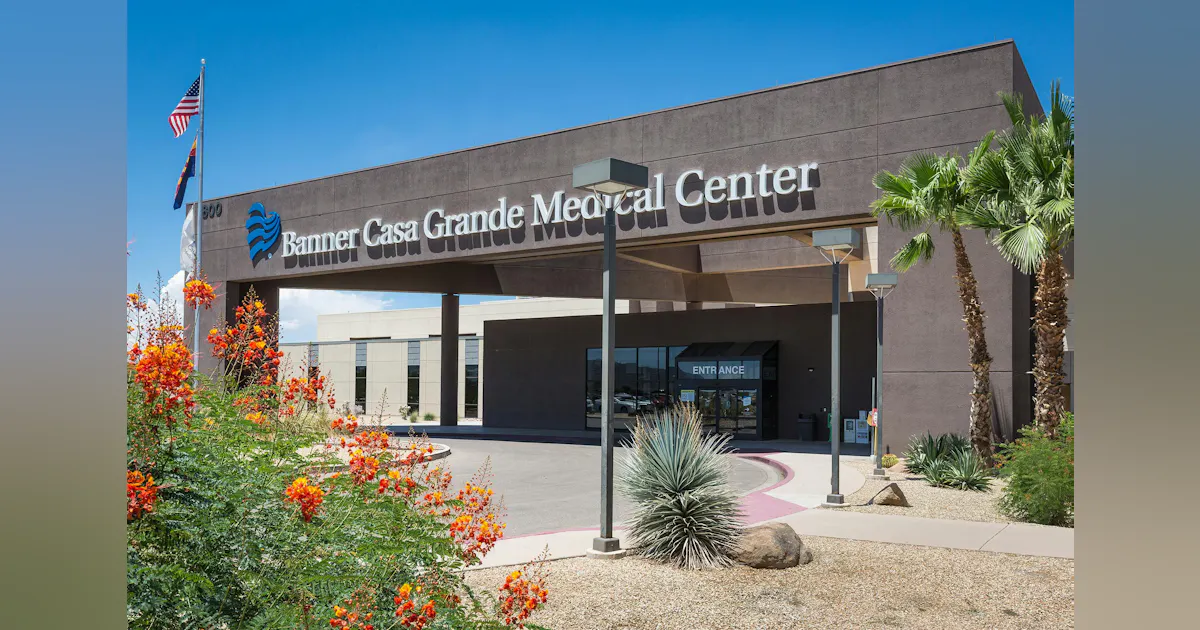
In March 2025, physician informaticist Alan Weiss, M.D., M.B.A., joined Phoenix-based Banner Health as senior vice president of clinical advancement to lead efforts to improve the effectiveness and efficiency of care delivery through technology. Banner’s telehealth, informatics, process engineering and clinical high-reliability groups report to him. He recently sat down with Healthcare Innovation to discuss decision-making around technology deployment and the latest AI developments at Banner.
Weiss has more than 24 years of experience as a physician informaticist with the Cleveland Clinic, Cedars-Sinai, Memorial Hermann and the BayCare Health System. At Florida-based BayCare, he was chief medical information officer. The nonprofit Banner Health has 33 hospitals, across Arizona, California, Colorado, Nebraska, Nevada and Wyoming.
Healthcare Innovation: After working as CMIO at BayCare Health System in Florida, what drew you to this position at Banner?
Weiss: It’s a much larger organization. My role here is much larger, and the diversity of what I oversee is greater. I am here to enable technology, which means not just implement what we have and refine it so we use it better, but go and find new stuff. And there are so many new technologies out there. The difficulty is trying to understand how we can use them and advance our outcomes at a time when there are lots of financial pressures.
HCI: Have you had a lot of experience working with external vendors and startups and are you bringing some new ways of thinking about that to Banner?
Weiss: I’ve worked with a lot of external vendors in my career, and had great experiences helping develop some of their products. One of the products that I helped develop at BayCare was an artificial intelligence chatbot that helped to triage the symptoms of a patient and direct them towards the right level of care.
HCI: From talking to other health system leaders, I gather that it can be challenging to figure out how to bring startups into the ecosystem and make sure that what they’re doing is having a positive impact for the health system.
Weiss: Absolutely. Both at BayCare and here, part of my role is to figure out how you work with these vendors, how to develop a business case for them, and to help implement the technology. I probably get pinged several times a week, either by a physician or executive who has seen something they want to explore. In fact, I joke that I feel like I’ve become the technology Santa Claus, where everybody’s giving me their wish list. It’s challenging, because trying to assess some of these products is difficult, and you’re trying to understand the impact of the technology on the organization, and assess it for ROI.
HCI: Most of the health systems we’re interviewing are deploying the ambient AI scribe tools and other AI tools for gathering and presenting disparate sources of patient data, as well as tools to improve documentation. Is Banner working on some of those things?
Weiss: Yes, all those things. In ambient listening we are piloting a couple of solutions on the ambulatory side. We started piloting one solution on the inpatient side. We’re going to move to a total of four solutions that we’re going to try on the inpatient side, and and the feedback from the doctors has been terrific. In fact, it’s been so good that a strategic planning group last week said, “Go faster, get it in there, start using it.”
HCI: So you’re doing a “taste test” of four different solutions?
Weiss: Yes. It is a lot of work. But we want to figure out which one works the best, and frankly, one might work better for some specialties than others. So it’s important that we do a thorough test. But I will tell you that I have used the ambient listening in clinic. I’m an internal medicine physician, and I’m a fast typist. I have all my macros set up, and it’s rare for me to not be done with a note by the time the patient leaves the room. I will tell you that it was freeing to have the ambient listening. You just don’t realize how much of your brain, your cognitive function, is spent thinking about how to create and organize your note. And I can definitely say, having used them, that I spend more time really talking to the patient, looking in their eyes, and thinking about the issues. I jot a couple of things down on a piece of paper, just to remember to ask something or order something, but not a lot. It’s pretty amazing to see the impact that it has.
HCI: What about tools that help with documentation and reporting to registries? Can the same vendors do that, or is that a separate set of vendors working on tools that do that part of it?
Weiss: All of those vendors are trying to do that. I don’t think any have succeeded as of yet, but they’re all working on it. There is additional work that’s going on with these ambient tools. Imagine that I’m having a conversation with you about the need for antibiotics, and in the conversation, I mention the antibiotic. It’s going to queue up the order. Well, that’s pretty phenomenal.
There are also quality-of-documentation type of nudges that are coming in. Let’s say a patient has congestive heart failure. There are different types of congestive heart failure. The tools are being built to nudge the provider to say which type the patient has. That can help get the documentation right just as you’re doing it, so you don’t have to go back later on.
HCI: Do you think the large EHR vendors themselves are working on the same type of AI tools themselves?
Weiss: Absolutely. We use Cerner. They are developing their own ambient listening, and it’s pretty good. I’m impressed. Everybody’s jumping into the space. We’re doing our own AI work. The tools have become so much easier to develop and build that you’re just seeing people jump in.
HCI: Does Banner also have an informatics team working on other ways to reduce burnout and improve clinician satisfaction with the EHR, and perhaps improve clinical decision support?
Weiss: Yes. One of the things that we are doing is automating processes. If I order a vaccine, there needs to be an order for drawing the vaccine, for administering it, for educating the patient on it, for putting in the bill. We’re automating all that, and it really reduces the burden on the provider and their staff.
We are also doing the same thing on the documentation side. If you call up for a refill, there are certain pieces of information that I want to know, including the last time you were in, the last time you got the refill, other medications you’ve got, and your labs. Well, previously, you had to do a chart dive and look for all that information. Now in a couple of keystrokes, you can bring that into your note. That makes it much easier, and is a much more standardized way to deliver care.
HCI: I understand you’re also in charge of telehealth efforts there at Banner as well. How deeply embedded are telehealth efforts in primary care and specialty care at Banner practices? Is there a lot going on through telemedicine partnerships with rural places in Arizona?
Weiss: It’s somewhere between 6% and 7% of our ambulatory visits, which is pretty much where most healthcare systems are. Certainly in the rural areas in Arizona — and we’re in five states — it’s a big boon to our providers and our patients. It’s a great capability and it’s embedded into their workflow so that it makes it pretty easy to do a telehealth visit.
HCI: Does banner also have an acute hospital-at-home program?
Weiss: We do not have a hospital-at-home program. It’s something we’re investigating.
HCI: It seems that with the hospital-at-home programs, the way Congress has funded it in six-month increments with the Medicare waiver has made investing in it more challenging.
Weiss: Yes, I think you’ve hit the exact issue. Why invest when you’re not certain of it long-term? I know of several health care systems that have done the investment and haven’t seen a lot of patients take up on hospital-at-home. I think it’s still amazing. I think it’s a great thing to do. I’m just not certain if it makes sense operationally or financially.
HCI: Does a lot of this work on things like improving documentation feed into Banner’s, participation in value-based care programs and do you talk to ACO leaders about what they need?
Weiss: I meet with our ACO group about every two to three weeks to understand their needs from a technology point of view. And they have a ton of technology that they’re bringing in involving data analytics workflow improvements. They also have a bunch of things that they want embedded into our electronic health record to try to nudge the providers to do the right thing. We are trying to make sure that we accomplish everything we need to do right up front in the process of delivering care.
HCI: How do you do strategic planning for digital health innovation in terms of thinking about where you want the health system to be in 2028 or 2030?
Weiss: There’s certainly a lot of stuff already in the hopper. We’ve got a lot of things that we already invested in, but there are a ton of additional investments that we are thinking about making. What we are trying to do is weigh what we need to invest in short-term and long-term. The financial situation across the country because of Medicaid cutbacks leave us with a lot of questions, so we are focusing on better understanding technology’s ROI.
link