

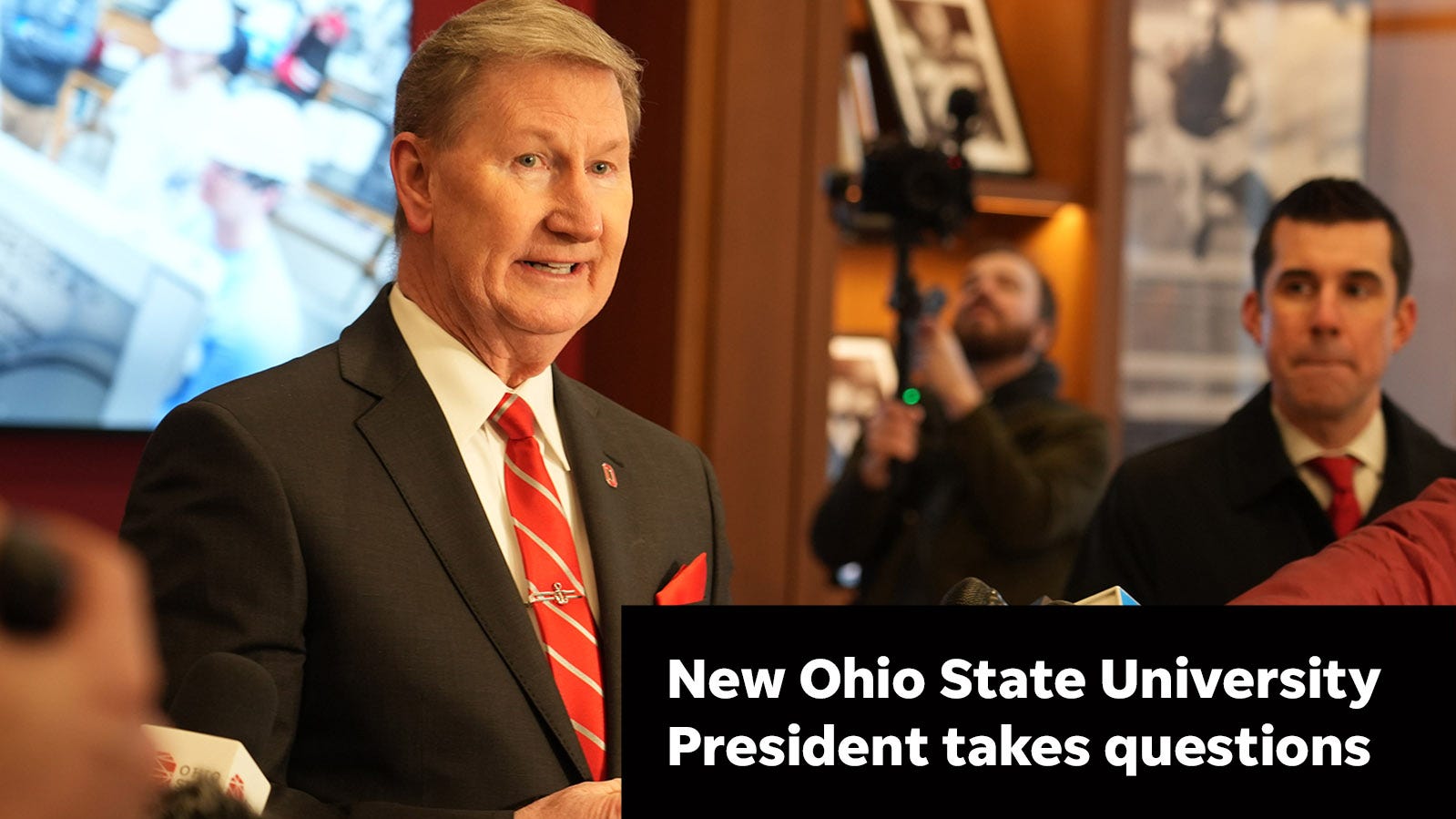

New Ohio State University president Ted Carter answers questions
Watch: New Ohio State University president Ted Carter takes tough questions on first day about Israel-Hamas War, Ryan Day, Leslie Wexner, Dr. Strauss
The artificial intelligence industry is growing, and with it, Columbus’ role on the world’s technology stage, according to billionaire Les Wexner.
Central Ohio is already home to a rapidly growing biotech hub of central Ohio, Wexner said, which he credited to the capital city being home to Ohio State University Wexner Medical Center and Nationwide Children’s Hospital. Now Columbus is set to be an international AI and medical technology destination, the billionaire said at the medical center’s May 20 board meeting.
Wexner, who is chairman of the board and for whom the medical center is named, said that “probably the largest AI investment in the world will happen in Columbus” and predicted that “100 more” medical technology companies will follow the incoming tech boom, drawn in by current economic development in the region.
“Columbus is the largest city in Ohio,” Wexner said. “We don’t publicize that – and I know in the real estate business that I’m in, people are always shocked at how big we are and how fast we’ve grown.”
Central Ohio’s current biotech landscape
Wexner is also the co-founder of New Albany Co., a private land acquisition company that owns much of the Columbus suburb’s quickly expanding business park.
Central Ohio is currently home to four major health systems and dozens of biotech companies, some of which are making their home in New Albany.
Peppered across the city are major construction projects from OhioHealth, OSU Wexner Medical Center, Mount Carmel Health Systems and Nationwide Children’s Hospital, including OSU’s nearly $2 billion hospital tower.
Most recently in the biotech sphere, Amgen announced a $900 million expansion of its New Albany pharmaceutical packaging plant, and supplement maker Pharmavite opened its $250 million gummy vitamin manufacturing facility.
Ohio State President Ted Carter has previously said he wants the university to be a leader in AI research. The university leads two federally funded AI projects — the AI Institute for Intelligent Cyberinfrastructure with Computational Learning in the Environment (ICICLE) and AI Institute for Future Edge Networks and Distributed Intelligence (AI-EDGE) — and joined a 14-institution international research consortium funded by OpenAI earlier this year.
Dispatch reporter Sheridan Hendrix contributed to this report.
Medical business and health care reporter Samantha Hendrickson can be reached at [email protected] or @samanthajhendr on X, formerly known as Twitter.
link